

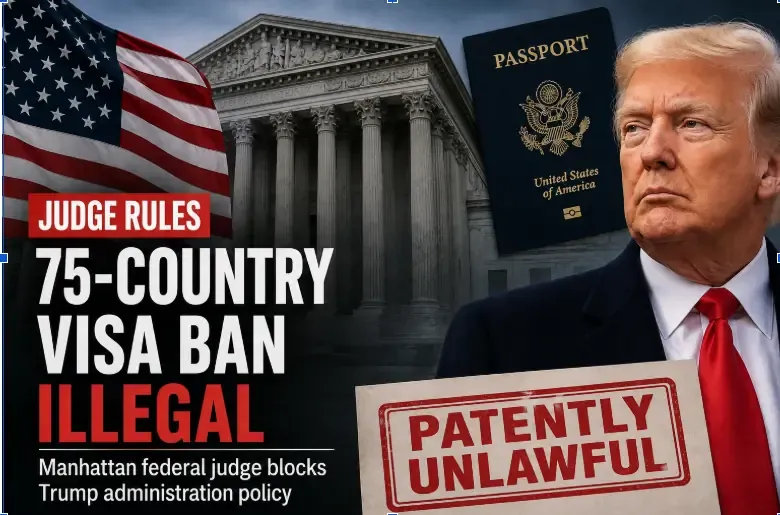
A federal judge in Manhattan has declared a sweeping visa policy, intended to suspend immigrant visas for citizens of 75 countries, to be unlawful within the current jurisdiction. The ruling, issued on Friday, August 21, 2026, by Judge Jeannette Vargas of the Southern District of New York, found the policy to be “patently unlawful.” According to the judge, the policy improperly interfered with the statutory authority of consular officers responsible for adjudicating immigrant visa applications for foreign nationals.
Visa Policy Deemed “Patently Unlawful”
The policy in question, proposed during the administration of President Donald Trump, sought to categorically prohibit the issuance of immigrant visas based solely on an applicant’s nationality. Judge Vargas stated in her ruling that this approach represented a “direct abrogation” of the established statutory scheme governing visa adjudications. The judge, who was reportedly appointed by former President Joe Biden, emphasized that the policy violated the existing legal framework for visas by imposing a blanket ban tied to national origin.
This significant decision came after a coalition of organizations, including the Catholic Legal Immigration Network and African Communities Together, alongside individual visa applicants and U.S. citizens sponsoring family members, filed a lawsuit challenging the policy. The plaintiffs argued that the broad restrictions were discriminatory and exceeded the executive branch’s authority.
Scope of the Affected Nations
The visa suspension encompassed a wide array of countries, affecting applicants from numerous regions globally. While the original report highlighted St. Kitts and Nevis, the policy’s reach extended to other Caribbean nations such as Antigua and Barbuda, the Bahamas, Barbados, Dominica, Grenada, Haiti, Jamaica, Saint Lucia, and St. Vincent and the Grenadines.
Beyond the Caribbean, the list of 75 affected states included countries from Latin America like Brazil, Colombia, and Uruguay; Balkan nations such as Bosnia and Albania; South Asian countries including Pakistan and Bangladesh; and numerous states across Africa and the Middle East. The sheer breadth of the policy underscored its significant impact on international travel and immigration to the United States.
State Department’s Rationale and Previous Restrictions
The State Department had defended the policy by asserting that nationals from the identified 75 countries posed a high risk of becoming a public charge in the U.S. This rationale suggested a concern that individuals from these nations might be unable to support themselves financially, potentially burdening public resources. The proposed visa suspension was presented as a measure to mitigate this perceived risk.
This policy followed a series of similar immigration restrictions implemented by the Trump administration. Notably, a broader travel ban affecting 39 states took effect on January 1, 2026. Additionally, a suspension of diversity visas commenced in late December 2025, further tightening U.S. immigration pathways for individuals from specific countries.
Reactions and Legal Challenges
The ruling was met with positive reactions from some international leaders. Gaston Browne, Prime Minister of Antigua and Barbuda, publicly welcomed the decision, sharing news of the development on his official Facebook page. This indicates a sense of relief and satisfaction among leaders of some affected nations.
Civil rights organizations have consistently alleged that such waves of restrictions constitute racial discrimination and violate the due process rights of foreigners seeking entry into the U.S. These groups argue that blanket bans based on nationality are inherently unfair and can perpetuate systemic biases. The legal challenges often center on whether the executive branch has the authority to implement such broad prohibitions without clear statutory authorization or evidence of individual ineligibility.
Ongoing Developments
As of the report’s publication, the State Department had not issued a public comment regarding Judge Vargas’s ruling. The department’s official response is anticipated, as such judicial decisions often prompt policy reviews or appeals. The outcome of this case could have lasting implications for U.S. immigration policy and the adjudication of immigrant visas for nationals of countries subject to such broad restrictions.
The legal battle highlights the ongoing tension between national security concerns, immigration control, and the rights of individuals seeking to immigrate to the United States. The court’s decision underscores the importance of statutory authority and due process in the implementation of immigration policies, particularly those that impose categorical restrictions based on national origin.
