

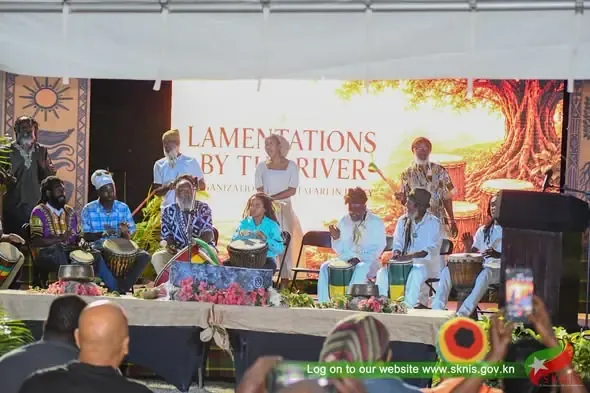
St. Kitts and Nevis recently held a solemn Night of Remembrance to honor the Kalinago people, commemorating the tragic massacre and expulsion that befell them centuries ago. The event, themed “Ancestral Echoes: Remembering the Blood, Honouring the Resilience,” took place on August 28, 2026, at the historically significant Bloody Point in Challengers Village. Its primary objective was to pay tribute to the lives lost and those forcibly removed from their ancestral lands.
Commemoration at Historic Bloody Point
The gathering at Bloody Point, a site deeply intertwined with the tragic history of the Kalinago people, drew a diverse assembly. Attendees included government officials, community members, nationals of St. Kitts and Nevis, and representatives from the Rastafarian community. Historians and cultural enthusiasts were also present, underscoring the event’s broad significance in acknowledging this pivotal moment in the nation’s past.
A key moment of the commemoration involved the lighting of a torch of remembrance. This solemn act was performed by Minister Samal Duggins, head of the Department of Cultural Heritage, alongside Anette Sanford. Ms. Sanford holds the distinguished position of being the first woman to lead the Kalinago Territory in 400 years, a milestone achieved in 2024. Together, they honored the memory of those who perished nearly four centuries prior.
During Ms. Sanford’s visit to St. Kitts and Nevis, she and Minister Duggins also visited Bloody Point itself. This location is starkly remembered as the site where, according to historical accounts, hundreds of Kalinago people were massacred by Sir Thomas Warner and his forces. The Night of Remembrance served as a poignant occasion to reflect on this dark chapter, which authorities acknowledge as one of the most tragic periods in the history of St. Kitts and Nevis.
Preserving Historical Memory and Indigenous Stories
The commemoration was more than just a moment of reflection; it was also a vibrant display of cultural heritage. Attendees experienced traditional drumming and dance performances, which officials noted significantly enriched the program. These artistic expressions served to connect the present with the past, offering a powerful reminder of the enduring spirit and cultural legacy of the Kalinago people.
The Department of Cultural Heritage organized the event with a clear vision: to preserve historical memory and ensure that the narratives of St. Kitts and Nevis’s indigenous inhabitants are passed down through generations. By actively remembering and recounting these stories, the initiative aims to foster a deeper understanding and appreciation of the nation’s complex history.
The Kalinago Massacre: A Historical Overview
The events leading to the massacre and expulsion of the Kalinago people from St. Kitts and Nevis represent a critical, albeit painful, part of the island’s history. While exact numbers and precise details are subjects of historical study, it is widely understood that conflict arose between the indigenous Kalinago and European colonizers. The specific incident at Bloody Point, where a significant number of Kalinago were killed, marks a turning point in the relationship between the indigenous population and the colonial administration.
The Kalinago, who inhabited the Lesser Antilles for centuries, had a rich culture and established societies prior to European arrival. Their displacement and the subsequent loss of life had profound and lasting impacts on their communities and the demographic landscape of the islands. The commemoration seeks to acknowledge this historical injustice and honor the resilience of the Kalinago people, whose descendants continue to maintain their cultural identity.
The Significance of Remembering
Events like the Night of Remembrance are crucial for national reconciliation and historical education. By confronting difficult aspects of the past, societies can foster greater understanding and empathy. The presence of Kalinago leadership, such as Chief Anette Sanford, alongside government officials and community members, signifies a step towards acknowledging historical truths and building stronger relationships.
The theme, “Ancestral Echoes: Remembering the Blood, Honouring the Resilience,” encapsulates the dual purpose of such commemorations: to acknowledge the suffering and loss while simultaneously celebrating the strength and enduring spirit of the Kalinago people. It highlights a commitment to ensuring that their history is not forgotten but is instead integrated into the broader narrative of St. Kitts and Nevis.
Looking Forward: Cultural Heritage and Future Generations
The Department of Cultural Heritage’s initiative underscores the importance of safeguarding intangible cultural heritage. The stories, traditions, and memories of the Kalinago people are vital components of the national identity of St. Kitts and Nevis. By organizing events that bring these histories to the forefront, the department aims to ensure that future generations have a comprehensive understanding of their nation’s origins and the diverse peoples who have shaped it.
The collaboration between government bodies, cultural organizations, and community groups demonstrates a unified effort to address historical legacies. The Night of Remembrance at Bloody Point serves as a powerful reminder of the past and a hopeful gesture towards a future where all historical narratives are acknowledged and respected, ensuring that the echoes of the ancestors continue to resonate with honor and remembrance.
