

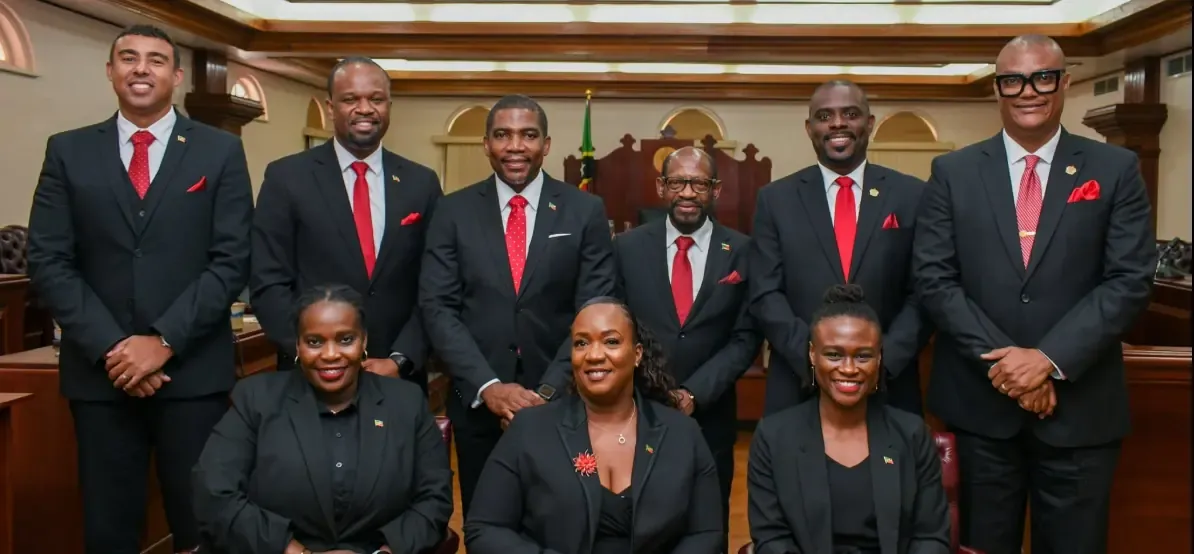
The St. Kitts and Nevis Labour Party (SKNLP) administration, led by Prime Minister Dr. Terrance Drew, has completed its first four years in office since being elected in August 2022. The party has outlined a vision for development and growth, implementing reforms and initiatives across various sectors including fiscal policy, infrastructure, social welfare, and international relations. This period has seen a focus on strengthening the nation’s economy, improving public services, and enhancing the quality of life for citizens.
Key Achievements in the First Four Years
Since taking office, the SKNLP administration has pursued a multi-faceted agenda. Prime Minister Drew, who also holds portfolios for Finance, Health, National Security, Social Security, and the Citizenship by Investment Programme, has overseen significant policy shifts. The government highlights strong fiscal reforms, a restructured Citizenship by Investment Programme, substantial infrastructural development, an expanded international presence, and increased wages and improved pension benefits for workers.
Social Welfare and Healthcare Initiatives
Two significant announcements were made during the cabinet’s swearing-in ceremony in August 2022. The first was the establishment of the Children’s Medical Fund, designed to provide financial assistance for overseas emergency medical treatment for children from disadvantaged families. This fund has reportedly helped numerous children receive critical care without imposing a financial burden on their families. Secondly, tuition fees were eliminated for citizens pursuing tertiary education at Clarence Fitzroy Bryant College, making higher education more accessible.
Rehabilitation and Development at JNF General Hospital
The Joseph Nathaniel France (JNF) General Hospital has been a focal point for rehabilitation and development under the current administration. Shortly after taking office, the government initiated roof repairs, addressing issues reportedly inherited from the previous administration. This project was undertaken in partnership with the Republic of China (Taiwan). Further enhancements included the rehabilitation of the hospital’s lobby, completed in October 2024, which saw upgrades to lighting, seating, signage, and the addition of a canteen. The psychiatric ward also underwent rehabilitation, and the national ambulance fleet was augmented with state-of-the-art vehicles in 2025. Plans are also in motion for the construction of a new, climate-smart JNF General Hospital, with preliminary requirements met and construction commencing in partnership with the Republic of China (Taiwan) and Overseas Engineering & Construction Company (OECC).
Enhancing Water Security and Educational Infrastructure
Improving water security has been a key objective. The commissioning of a 2 Million Gallon Desalination Plant is cited as a major success, significantly increasing water access. Additionally, a water well was commissioned in Cayon, addressing long-standing water insecurity issues and providing near 24-hour supply. Drilling for another water well in the Saddlers community began in July 2026. Official figures indicate a rise in access to regular potable water from just over 24% to 70% of the population on St. Kitts since the administration took office.
Educational Infrastructure Projects
In education, the administration is overseeing the construction of the new Basseterre High School, a modern facility intended to replace a project that had been pending for nearly a decade. The Joshua Obediah William Primary School is also undergoing final stages of rehabilitation, with a target reopening in 2027. These projects have garnered positive attention for the administration.
Crime Reduction and Skills Development
The government reports a historic decrease in crime and violence during its tenure, with homicides reportedly falling by 75%. This reduction is noted as the most significant in two decades and has attracted regional and international attention. Concurrently, efforts have been made to enhance the skills of the workforce through training, workshops, and Technical and Vocational Education and Training (TVET) courses.
Economic Empowerment and Social Support
The SKNLP administration has implemented systematic increases to the minimum wage. The first adjustment in January 2024 raised it from $9 per hour to $10.75 per hour. A further increase in July 2025 brought it to $12.50 per hour. Civil servants received an 8% salary increase. The Budget Boost Wallet program provided financial assistance to over 22,000 citizens in the first half of 2025, with a $30 million investment aimed at mitigating the effects of global inflation. Government Auxiliary Employees are now receiving pensions, aligning them with other public service employees. Frontline workers who served during the pandemic received their due honorariums. A significant policy change provides government employees with lifetime health insurance coverage, removing the previous age limit of 75.
Citizenship and Economic Dividends
Citizens have received two Citizenship by Investment (CBI) dividend payouts. Additionally, a $1,000 Independence Payment was issued to citizens. These measures are part of the administration’s strategy to distribute economic benefits directly to the populace.
Economic Performance and International Standing
St. Kitts and Nevis boasts the highest Human Development Index ranking in CARICOM, surpassing several regional counterparts. Unemployment remains below 5%, with a record 30,000 individuals actively contributing to Social Security. The tourism sector has shown robust recovery, with cruise passenger arrivals exceeding 900,000 during the 2025-26 season. Air arrivals and stayover tourists have also seen a substantial increase. The nation is preparing for homeporting operations for P&O Cruises, a development supported by the groundbreaking of a new Cruise Terminal at Port Zante in July.
Regional Leadership and Diplomatic Expansion
Prime Minister Dr. Terrance Drew served as Chairman of the Caribbean Community (CARICOM) from January to June 2026, during which St. Kitts and Nevis hosted the 50th CARICOM Heads of Government meeting. The nation also opened its first High Commission in New Delhi, strengthening diplomatic ties with India. The government has provided aid and support to regional partners affected by climate-related emergencies.
Reforms to the Citizenship by Investment Programme
The Citizenship by Investment (CBI) Programme has undergone significant reforms since December 2022. These include establishing a technical committee for application review, criminalizing underselling practices, and strengthening due diligence and application requirements. In July 2023, the minimum investment was raised to US$250,000, and a new Sustainable Island State Contribution option replaced the Sustainable Growth Fund, directing funds towards national development. St. Kitts and Nevis, along with other Caribbean nations, established the Eastern Caribbean Citizenship by Investment Regulatory Authority (ECCIRA) for joint regulatory oversight. In June 2024, the Citizenship by Investment Unit was converted into an independent statutory body. Mandatory residence and biometric screening requirements have been implemented for applicants. These reforms led to the rescission of a 2014 US advisory against the program in February 2026 and the program was recognized as “Programme of the Year” at CIS 2026.
Modernizing Travel and Digital Transformation
The National Biometric Enrolment and Passport Modernisation Programme is underway, aligning the country’s travel practices with international standards as part of a broader digital transformation initiative.
Conclusion
Over its first four years, the St. Kitts and Nevis Labour Party administration, under Prime Minister Dr. Terrance Drew, has focused on implementing substantial reforms and developmental projects. The government emphasizes its commitment to economic prosperity, social well-being, and strengthening the nation’s international profile through strategic initiatives in healthcare, education, infrastructure, and economic policy.
