

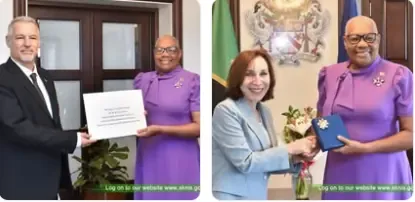
St. Kitts and Nevis has officially welcomed two new resident ambassadors, representing Brazil and Israel, as they presented their letters of credence to Governor General Dame Marcella Liburd. The formal ceremonies, held at Government House, marked the commencement of their diplomatic tenures and underscored the nation’s ongoing efforts to strengthen international relationships.
Brazilian Ambassador Presents Credentials
The first to present her credentials was Marcia Donner Abreu, the new Non-Resident Ambassador of Brazil to St. Kitts and Nevis. Ambassador Abreu will operate from the Brazilian Embassy in Bridgetown, Barbados, throughout her assignment. She succeeds Ambassador Vera Lucia dos Santos Caminha Campetti, who has concluded her tour of duty and returned to Brazil.
The establishment of formal diplomatic relations between Brazil and St. Kitts and Nevis dates back to March 12, 1985, a little over a year and a half after the twin-island federation gained its independence. This long-standing relationship continues to be nurtured through the appointment of resident ambassadors who facilitate closer cooperation and understanding.
Israeli Ambassador Assumes Diplomatic Role
Following the Brazilian ambassador, Oren Bar-El presented his credentials, formalizing his appointment as Israel’s Ambassador to St. Kitts and Nevis. Ambassador Bar-El, who is based in the Dominican Republic, will also serve as Israel’s non-resident ambassador to several other Caribbean nations, including Antigua and Barbuda, Dominica, Grenada, Haiti, Jamaica, Saint Lucia, and Saint Vincent and the Grenadines.
The appointment of Ambassador Bar-El is expected to bolster St. Kitts and Nevis’ standing within the international community. Israel and St. Kitts and Nevis established formal diplomatic ties in January 1984, within the initial six months of the latter’s independence. This early establishment of relations highlights a consistent commitment to bilateral engagement.
Strengthening Bilateral Ties and Strategic Alliances
The acceptance of credentials by the Governor General signifies the federation’s dedication to improving its bilateral ties and enhancing strategic alliances globally. These diplomatic engagements are crucial for fostering economic development, promoting cultural exchange, and ensuring security cooperation.
The Significance of Non-Resident Ambassadors
The model of non-resident ambassadorship, employed by both Brazil and Israel in their relations with St. Kitts and Nevis, is a common practice in diplomacy, particularly for smaller nations or those with extensive diplomatic portfolios. This approach allows countries to maintain formal diplomatic representation and engage in bilateral activities without the need for a full resident embassy in every nation.
- Efficiency: It allows for the efficient allocation of diplomatic resources, enabling ambassadors to cover multiple countries from a single base.
- Broader Reach: It facilitates broader diplomatic engagement across a region, fostering relationships with a wider array of nations.
- Cost-Effectiveness: For both the sending and receiving countries, it can be a more cost-effective way to manage diplomatic relations compared to establishing and maintaining resident embassies.
Historical Context of Diplomatic Relations
The formalization of diplomatic relations between St. Kitts and Nevis and Brazil in 1985, and with Israel in 1984, occurred shortly after the nation gained independence in 1983. This period was critical for the newly independent nation as it sought to establish its place on the world stage and build connections with diverse international partners.
- Brazil: Formal relations established on March 12, 1985.
- Israel: Formal relations established in January 1984.
These early diplomatic overtures laid the groundwork for the ongoing cooperation and mutual understanding that characterize the relationships today. The continuous accreditation of ambassadors, even on a non-resident basis, demonstrates the enduring importance placed on these international connections.
Looking Ahead: Future of Diplomatic Engagements
The arrival of Ambassador Abreu and Ambassador Bar-El signals a renewed focus on diplomatic engagement for St. Kitts and Nevis. Their tenures are expected to foster continued collaboration in areas of mutual interest, potentially including trade, investment, education, and security. The government’s commitment to enhancing its global presence through such diplomatic appointments is a testament to its forward-looking foreign policy.
As these ambassadors embark on their duties, they will play a vital role in representing their respective nations and strengthening the bonds with the Federation of St. Kitts and Nevis. Their work will contribute to the broader objective of fostering a more interconnected and cooperative international environment for the nation.
